Marketplace
- Document
NetworkNature Factsheet - Nature-based solutions: are we restoring our relationship with nature in Europe?
To achieve a sustainable future, we should work with, not against nature to achieve global goals. Nature-based solutions are a great pathway forward. This Factsheet was produced by NetworkNature to provide an overview of some of our current societal challenges in different sectors and practical
- Document
- Guidance
Addressing Climate Change in Cities – Policy Instruments to Promote Urban Nature-based Solutions
This guidance document responds to exisiting gaps and highlights a range of policy and supporting instruments relevant for NbS design, implementation and maintenance. Policy instruments include regulations, strategies, programmes, action plans and financial incentives. The guidance aims to support

- Document
- Guidance
The Cities and Biodiversity Outlook - URBES Factsheet #4
This Factsheet highlights some of the mian highlights from the Cities and Biodiversity Outlook - the first scientific assessment of how global urbanization trends affect biodiversity and ecosystem dynamics. It explains how biodiversity and ecosystem services can be managed and restored in
- Document
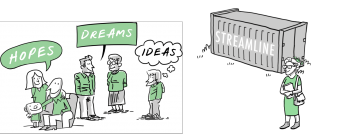
STREAMLINE
STREAMLINE is a new format for semi-structured, one-on-one interviews. In its current form STREAMLINE consists of a set of colorful, laminated A3 canvasses. Set in the future, each canvas invites the interviewee to set out their vision on a particular topic through a series of questions and tiles.
- Software
- Training
- Video
PhusicosVR - NbS demonstrators in Virtual Reality
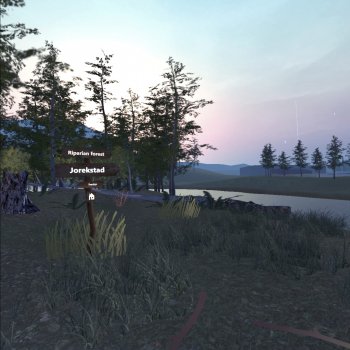
The H2020 project PHUSICOS focused on demonstration sites for NbS implementations to reduce hydrometrological risks in rural environments. These implementations are difficult enough to envision for professionals familiar with them, such as landscape architects and infrastructure engineers, but for
- Document
- Guidance
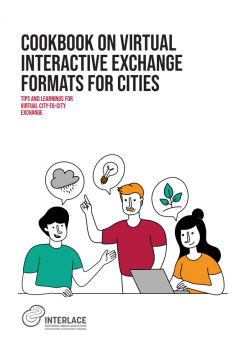
Cookbook on virtual interactive exchange formats for cities
The ‘Cookbook on virtual interactive exchange formats for cities’ is a collection of virtual collaboration methods tested and evaluated in the INTERLACE project. It can be a particular challenge to build collaboration and trust between cities merely online, but the available methods and tools were
- Paper
Nature-based solutions coupled with advanced technologies: An opportunity for decentralized water reuse in cities
Decentralized water reuse in cities is a prominent alternative to mainstream top-down models for urban water treatment, which are based on centralized, linear dynamics of resource management. In this sense, Nature-based Solutions (“green” technologies) coupled with advanced technologies (“grey”
- Infographic
Demonstrating the impact of innovative nature-based solutions
This Infographic shows the environmental, social and economic impact of innovative nature-based solutions in Connecting Nature cities Genk, Glasgow, and Poznań.
- Infographic
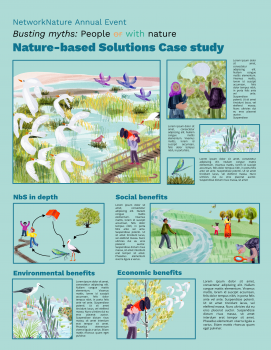
Virtual Exhibition of Selected NbS Case Studies | NetworkNature Annual Event 2024
As part of the NetworkNature Annual Event 2024 "Busting Myths: People with Nature," a special poster exhibition was held alongside the panels and presentations. This exhibition showcased 9 Nature-based Solutions case studies from across the globe, offering participants a deeper
- Policy Brief
The proposed EU Nature Restoration Law: what role for cities and regions?
This policy brief takes a fresh look at the implications of the European Commission’s proposed Nature Restoration Law for cities, regions and local actors. The first of its kind, this paper looks at what the Law holds in store for these governments and authorities – actors on the front lines of the
- Report
From Nature-based Solutions to the Nature-based Economy - Delivering the Green Deal for Europe (Draft White Paper for consultation)
Decades of research and more recently public policy recognise that current economic practices are not compatible with a healthy planet. The European Green Deal aims to decouple economic growth from resource usage, decarbonise industry and do this in a fair and just way for society. Nature-based

- Slides
Presentation on climate-proofing cities through nature
This powerpoint slide provides a case study on a successful example of nature-based solution applied in the urban context: The implementation of urban parks and green areas with sustainable urban drainage systems to handle excess rainwater in Aarhus. This initiative was implemented under the SPARK
- Training
- Video
INTERLACE MOOC on Nature-based Solutions: (7) POLICY INSTRUMENTS for mainstreaming NbS in urban governance processes
Urban areas across the globe are facing unprecedented challenges—pollution, climate change, urban sprawl—and traditional solutions are falling short. The INTERLACE project’s Massive Open Online Course showcases how nature-based solutions offer a promising approach to help create resilient,
- Document
URBAN GreenUP good practice kit
This kit will help you in using Nature-Based Solutions (NbS) to make your city more liveable and resilient to climate change. It offers a set of best practices and recommendations that cover all the stages of NbS implementation: how to select the right NbS, how to set one up, and how to monitor it
- Video
My building is green Nature-Based Solutions for Adapting Buildings to Climate Change
In the following video, different people involved in and/or affected by the LIFE-myBUILDINGisGREEN project explain the characteristics and benefits derived from the Nature-Based Solutions (NbS) implemented by the project in the Gabriela Mistral school from Solana de los Barros, province of Badajoz
- Document
- Product
- Paper
Science-based ecosystem restoration for the 2020s and beyond
The documenti presents recommendations of the Science Task Force (STF) of the UN Decade for Ecosystem Restoration, led by the International Union for Conservation of Nature (IUCN) and comprised of leading subject experts as specific actions to be undertaken by public and private stakeholders to

- Document
- Product
- Report
The nature of Manchester. Local Action Project
In 2017, the City of Manchester become one of the 22 ‘Citylab’ study cities being undertaken across Europe as part of the European Commission Joint Research Centre (JRC)-funded EnRoute Project. The EnRoute (enhancing the resilience of urban ecosystems through green infrastructure) Project forms a
- Report
Guiding Framework for Tailored Living Lab Establishment
Multi-stakeholder participation is an overarching issue of PHUSICOS and, as such, forms a foundation to foster innovation at all levels and at all case study sites. Workpackage 3 is dedicated to employ a Living Lab approach as key mechanism of local stakeholder involvement for the purpose of
- Product
NBS EduWORLD Flipbook - Nature-based Solutions-Learning from NBS EduSystems inspiring initiatives
Nature-based solutions (NBS) have gained solid ground in urban planning and design over the last decade. However, NBS education is still in a nascent stage and thus there is a gap in knowledge, skills and awareness of younger generations to be prepared to support mainstreaming NBS in all sectors

- Training
- Software
- Document
Business Ecosystems Training
Business Ecosystems Training (BET) course is a freely-available capacity building program to increase the knowledge and understanding of the links between ecosystems and business. The objective of BET course is to equip companies with the skills they need to better manage their impacts and
- ‹ previous
- 30 of 45
- next ›