- Report
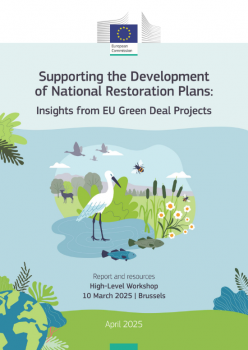
Supporting the Development of National Restoration Plans
Under the Horizon 2020 Green Deal Call, four major nature restoration projects are being funded – MERLIN, REST-COAST, SUPERB, and WaterLANDS. On 10 March 2025, the four projects held a high-level meeting at the European Commission in Brussels to present and discuss evidence-based recommendations
- Guidance
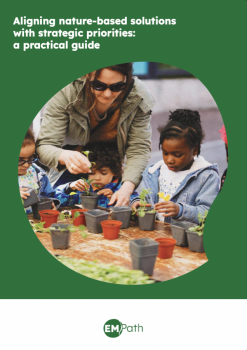
Aligning nature-based solutions with strategic priorities: a practical guide
Urban nature-based solutions have the potential to offer cities a range of opportunities to build climate resilience, improve people’s health and wellbeing, foster social cohesion, enhance biodiversity and develop nature-based enterprises that contribute positively to local economies, all while
- Guidance
- Guidance
ISO 14091:2021 Adaptation to climate change — Guidelines on vulnerability, impacts and risk assessment
This document gives guidelines for assessing the risks related to the potential impacts of climate change. It describes how to understand vulnerability and how to develop and implement a sound risk assessment in the context of climate change. It can be used for assessing both present and future
- Dataset
Resource List: Criteria and Requirements for High-Quality Nature-based Solutions
This review includes a list of selected resources that discuss the criteria and the requirements of high-quality nature-based solutions (NbS). The list consists of resources that offer a comprehensive approach to NbS quality considerations and documents that focus on specific aspects of NbS quality

- Event
- Slides
ZÖLD-KÉK INFRASTRUKTÚRA: Zöld(-kék) infrastruktúra workshop önkormányzatok részére című esemény előadásai (2023.11.14.)
Magyarország Miniszterelnökségének Közlekedési, Környezeti és Energiahatékonysági Fejlesztési Programok Végrehajtásáért Felelős Helyettes Államtitkársága 2023. november 14-én szakmai szemléletformáló rendezvényt szervezett ”Zöld-(kék) infrastruktúra (ZI) workshop Önkormányzatok részére” címmel.
- Document
Developing a Novel Martelloscope for Assessing Biodiversity and Growing Stock Volume with the aid of a Digital Twin.
Monitoring and quantifying biodiversity variation through silvicultural choices made with the marteloscope adds significant value to sustainable forest management, enhancing ecosystem services and production aspects.
- Paper
Innovation in NbS Co-Desing and Implementation
Article published in Sustainability. From the published abstract: Impacts in the form of innovation and commercialization are essential components of publicly funded research projects. PHUSCOS ("According to Nature" in Greek), an EU Horizon 2020 Program (H2020) Innovation Action project

- Document
Interlace Stakeholder Engagement Strategy
Stakeholder engagement is a central element of the INTERLACE project as it aims to co-produce tools, governance instruments and other project deliverables with local stakeholders, as well as facilitate knowledge exchange between local, regional and global stakeholders, to inform and support the
- Document
- Image
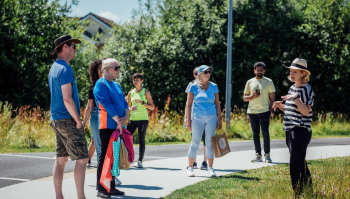
Seedbed Intervention Images
Do you want to feel the full experience of our recent Seedbed Interventions in the Seed Cities of Burgas, Limerick, Lahti, Umea, Tallinn and Versailles? Fear not. You can see for yourself in this gallery of imagery from the interventions. Publication Date: 03 Feb 2023 Author(s): City of
- Document
The ARCHI method: a tool for diagnosing the vitality of trees
ARCHI method is focused on the architecture of a tree, as a real biological signature of its vitality, that must constantly be evaluated with different physiological states
- Document
- Guidance
Cookbook on virtual interactive exchange formats for cities
The ‘Cookbook on virtual interactive exchange formats for cities’ is a collection of virtual collaboration methods tested and evaluated in the INTERLACE project. It can be a particular challenge to build collaboration and trust between cities merely online, but the available methods and tools were
- Training
Urban Nature Explorer
A simulation game to address sustainability challenges through nature-based solutions.
- Empty
CAPACITY-BUILDING MATERIALS AND EDUCATIONAL PACK IN LOCAL LANGUAGES
A set of capacity building materials has been produced to raise awareness and understanding of the definition of nature-based solutions adopted by the UN Environment Assembly in 2022. Materials include infographics that contain the full meaning of the definition and a video that introduces
- Infographic
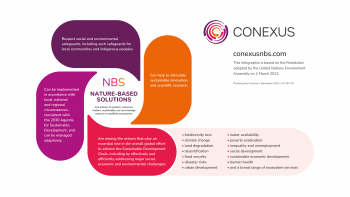
Nature-based solutions definition infographics II
The adoption of the globally agreed definition of nature-based solutions by the UN Environment Assembly in March 2022 was a great boost to international collaboration. It placed the focus sharply on accelerating the implementation of nature-based solutions to tackle societal challenges. To help
- Document
Specific silvicultural itineraries to optimize the production of quality timber and economic yield of Pinus pinaster.
Four silvicultural scenarios have been created considering the wood quality: - Standard scenario (M2): Involves three thinnings and a final felling. - Short rotation scenario with subsidies (M4): Includes one thinning and a final felling. - No management scenario (M8): Only comprises a final
- Policy Brief
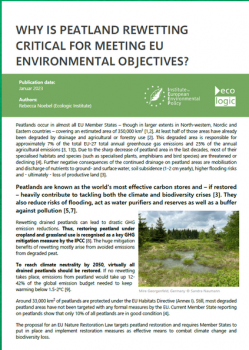
Why is Peatland Rewetting Critical for Meeting EU Environmental Objectives?
The EU Commission published its proposal for a new Nature Restoration Regulation in June 2022. In this context, Ecologic Institute and IEEP – as part of the Think Sustainable Europe network – published a series of thematic policy briefs to inform Members of the European Parliament and other
- Document
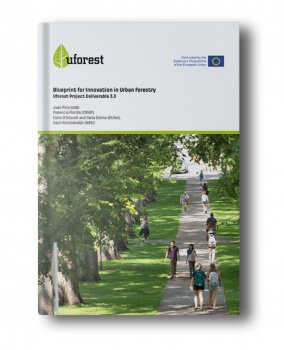
Blueprint for Innovation in Urban Forestry
Blueprint for Innovation in Urban Forestry: a review of urban forestry’s potential for a healthier and more sustainable future Urbanisation is a global trend: according to the United Nations Department of Economic and Social Affairs (UN DESA), today 55.5% of the world’s population lives in urban
- Guidance
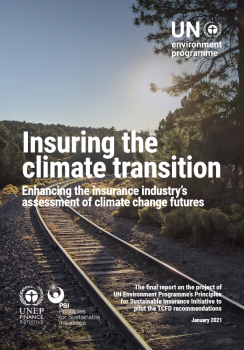
UNEP’s Principles for Sustainable Insurance Initiative (2021): Insuring the climate transition: The final report of UN PSI’s TCFD pilot project
The insurance industry is one of the largest global industries with more than USD 6 trillion in world premium volume and USD 36 trillion in assets under management. As such, insurers hold a significant portion of global economic assets and liabilities on their balance sheets. As risk managers,
- Guidance
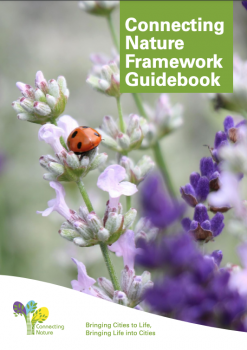
Connecting Nature Framework
Connecting Nature has developed an introductory guidebook to the overall Connecting Nature Framework and a series on each of the individual elements to assist you develop your nature-based solution.
- ‹ previous
- 13 of 20
- next ›