Marketplace
- Document
- Guidance
OpenNESS Synthesis paper: Ecosystem services and human health
Synthesis paper on ecosystem services and human health. There may be scope for OpenNESS to demonstrate a benefit of the ecosystem services and natural capital concepts in shaping a more systemic understanding of how biodiversity supports health aspects of well-being.
- Document
- Guidance
OpenNESS Synthesis paper: Ecosystem service trade-offs and synergies
Despite its popularity, the intuitive definition of 'ES trade-offs' and its antonym 'ES synergies' lack conceptual clarity. When moving from theoretical concepts towards scientific comparison, more analytic definitions are required. In this SP, we further explore the trade-offs
- Video
- Web platform
CO-IMPACT tool
Developed within the Connecting Nature Project, CO-IMPACT is a decision-support tool allowing officers and cities to create impact assessment plans for their NbS/projects. The main objective is to make the process of building a baseline and impact assessment plan straightforward and simple for
- Document
Decisional Support System to support the revision of forest management plans
OG FORTRACK utilized spatial methods to quantify carbon stock, biomass, and forest types, creating a Decision Support System that facilitates report generation and lowers costs for forest managers.
- Document
- Guidance
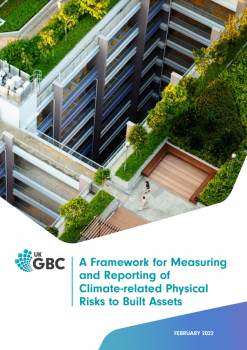
A Framework for Measuring and Reporting of Climate-related Physical Risks to Built Assets
In August 2021, UKGBC launched the Measuring and Reporting Climate-related Physical Risks task group in response to the upcoming mandatory disclosure of climate-related risks. For large organisations and financial institutions within the UK, this comes into force from April 2022 in line with the
- Guidance
GIZ ValuES - Method Profile: Assessing flood prevention potential of wetlands
Wetlands can absorb excess water in cases of river flooding. This method can be used to estimate the retention capacity of wetlands for flood mitigation and thereby protecting downstream inhabitants. For this, the impact of water detention on peak flows is considered, as well as the extent and
- Empty
Common Action Plan on clustering activities D1.3
This deliverable presents a summary of planned joint activities among the cluster of projects funded under the EU Horizon call H2020 SC5-14-2019 (Visionary and integrated solutions to improve well-being and health in cities).

- Document
- Guidance
The SPIRAL synthesis report: A resource book on science-policy interfaces
This is a resource book on good practices to improve the effectiveness of existing science-policy interfaces or develop new ones. The resource book synthesises information gathered and research done throughout the SPIRAL project (‘Science-Policy Interfaces: Research, Action and Learning’). The
- Guidance
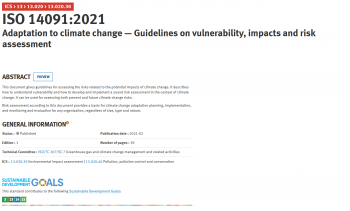
ISO 14091:2021 Adaptation to climate change — Guidelines on vulnerability, impacts and risk assessment
This document gives guidelines for assessing the risks related to the potential impacts of climate change. It describes how to understand vulnerability and how to develop and implement a sound risk assessment in the context of climate change. It can be used for assessing both present and future
- Document
- Product
- Report
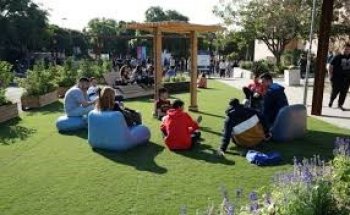
CONNECTING NATURE CITY REPORT MALAGA, Urban garden in Lagunillas
The City of Malaga is implementing measures to improve the environment and thus also improve the quality of life of its citizens. The city is exploring ways to restore an ecosystem damaged by the impact of economic activity and through the Connecting Nature project, learn more about the

- Video
Nature-based solutions in the GrowGreen cities: videos
As the evidence base on the role and benefits of nature-based solutions (NbS) grows rapidly, these solutions are featuring with increasing prominence in global climate change policy, stressing the importance of their implementation in urban environments. The Horizon2020 project GrowGreen has
- Document
- Training
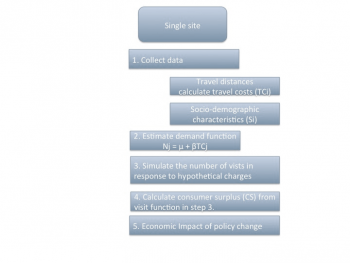
Method Factsheet - Travel Cost Valuation
The travel cost methods (TCM) is based on the observation that recreational services can only be realised through physical access to nature. This implies that individuals seeking to enjoy the service will need to spend resources (time and money) to travel to the site. The travel activity is a

- Document
The Ecoregions of Italy
In Italy, ecoregion classification, based on detailed scientific data, represents a framework that is used to effectively address national strategies for sustainability and harmonise landscape planning according to European policies (Habitats Directive; European Landscape Convention; Pan-European
- Document
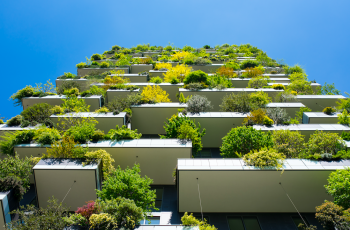
Group Certification for Sustainable Forest Management: Promoting Shared Forest Management and Ecosystem Services Enhancement
This certification is proof of the possibility of overcoming territorial fragmentation for a common objective by uniting public and private forces.
- Document
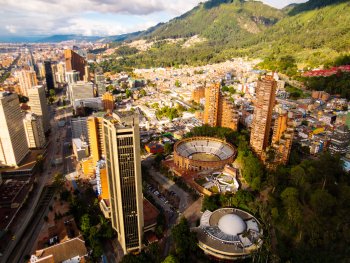
GUÍA DE LA INFRAESTRUCTURA VERDE MUNICIPAL
Esta Guía se redacta con el objetivo de dar respuesta a las necesidades que los responsables municipales tienen a la hora de gestionar de forma adecuada la infraestructura verde situada en su ámbito municipal. Está destinada principalmente a apoyar a los técnicos municipales y a los cargos
- Document
D5.1: Report on comparative analysis of economic valuation models
Findings are presented from an investigation of nature-based solutions (NBS) research and case studies examining how projects address ‘co-benefits’, and particularly, their coverage of economic impacts.

- Document
- Training
Helping Ecosystems in Europe to adapt to climate change
This report summarises much of the work done by, and for, the Climate Change Group of the European Network of Heads of Nature Conservation Agencies (ENCA) between 2011 and 2013.
- Document
- Infographic
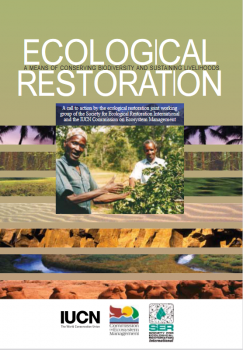
Ecological Restoration – a means of conserving biodiversity and sustaining livelihoods
Many of the world’s ecosystems have undergone significant degradation with negative impacts on biological diversity and peoples’ livelihoods. There is now a growing realisation that we will not be able to conserve the earth’s biological diversity through the protection of critical areas alone. This
- ‹ previous
- 38 of 45
- next ›