Marketplace
- Consultancy
- Guidance
Flood -Turning Disaster to Market
Losing crops is very common with food and other things in a natural disaster. This age, we are all facing this; so why not use the disaster as option. I choose flood to turn it to option. Flood supports surface recharge with vegetation and many other factors. If we coordinate this with management

- Document
Conexus Life-Lab factsheet series - Towards a green infrastructure system for Santiago de Chile
The pilot Santiago+ Green infrastructure (Stgo+) Plan started in 2018 led by the University of Chile, the Regional Ministerial Secretariat of Housing and other strategic partners. Through a broad participatory process, a plan is created which synthesizes ideas and initiatives into a vision to

- Document
- Guidance
FINAL REPORT – EKLIPSE REQUEST ON SUPPORTING EU NEGOTIATORS AT IPBES PLENARY
This report provides the summary of findings by the EKLIPSE ‘Expert Working Group analysing the links between the IPBES Global Assessment (GA) and its Summary for Policymakers (SPM). The Expert Working Group (EWG) was established based on a request by the European Commission, DG Environment, and
- Document
- Training
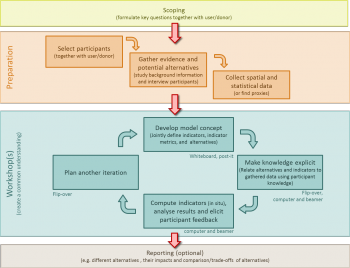
Method Factsheet - Quickscan
The QUICKScan software and QUICKScan tool (http://QUICKScan.pro) encompasses a modelling environment with functionalities to assess societal and environmental conditions, diagnose patterns and interactions, implement alternative responses and evaluate the impacts of those responses. The QUICKScan
- Document
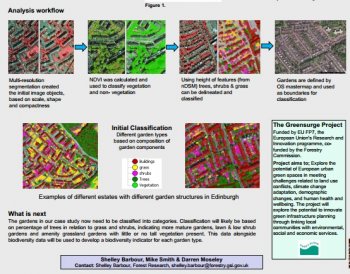
Using Object Based Image analysis to delineate garden structures in an urban environment
The accurate identification of greenspace typologies enables assessment of the contribution that urban greenspaces make to biodiversity, improving peoples well-being and the green economy, a focus of the EU FP7 project GREENSURGE. It has been shown that the conventional pixel by pixel
- Document
- Training
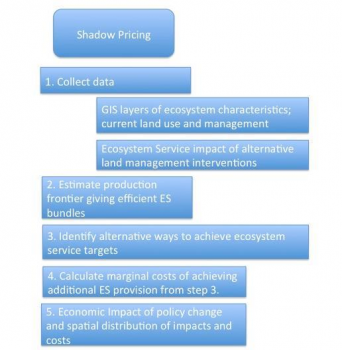
Method Factsheet - Shadow Pricing
Shadow pricing is highly appropriate to elicit monetary values and anthropocentric instrumental values of nature's benefits. When society sets environmental targets on the provision of non-marketed ecosystem services it is an implicit valuation of the services. The shadow price is the marginal
- Document
The uptake of new concepts in urban greening: Insights from Poland
The idea of nature having multiple benefits for urban management and planning is gaining prominence alongside the rise of climate change awareness. It is expressed through concepts such as nature-based solutions (NbS), ecosystem-based adaptation (EbA), and blue-green infrastructure (BGI). Despite

- Empty
Terms of Reference for Urban Well-being Labs and associated local task forces in each of the cultivating cities
This ToR document refers to the intended development of Urban Well-Being Labs and the further establishment of a Local Task Force in each of the six participating cities. In the context of this ToR document, a focus is placed on the following key factors: • Listing of all definitions of
- Guidance
ZÖLD-KÉK INFRASTRUKTÚRA: Útmutató esőkertek építéséhez
"Az elmúlt években az éghajlati változások miatt olyan környezeti változásokkal kellett szembesülnünk, amelyek komoly negatív hatást gyakoroltak életünkre. Ezeknek a negatív hatásoknak az egyik oka a csapadék jellemzők megváltozása. Megoldást a szemléletváltás jelenthet, ami a csapadékvizek

- Document
Conexus key learning factsheet series - Supporting Nature-based Solutions via Nature-Based Thinking
In response to critiques of Nature-based Solutions (NbS), we propose a holistic and systemic approach: Nature-Based Thinking (NBT). NBT emphasizes the inspiration from nature to foster sustainable urban development and conceives nature to be intertwined with people. NBT will engage local actors,
- Document
- Guidance
Urban resilience and sustainability - URBES Factsheet #5
This factsheet explains the importance of understanding the relationship between people and nature in urban planning and decision making in order to achieve urban resilience and sustainability.
- Report
GrowGreen Report: Intervention Conclusions: Valencia
Within the EU-funded GrowGreen project, this report presents the challenges and results from the work in Valencia, focused on Benicalap, an area located in the north west of the city, chosen for the need for regeneration and investment. The aim of this report is to demonstrate how NbS can help
- Document
- Training
Method Factsheet - Photoseries Analysis
Revealed preference for Cultural Ecosystem Services (CES) and spatially-explicit data on location for nearby CES provision can be obtained from popular social networks. Photoseries databases can be acquired from photo-sharing websites such as Flickr, Panoramio and Instagram. The analysis of

- Guidance
Virtual Landscape Theatre
The Virtual Landscape Theatre (VLT) is a mobile curved screen projection facility, in which people can be 'immersed' in computer models of their environment to explore landscapes of the past, present and future. This facility is the first mobile unit of its kind in the UK, and is used for
- Video
PHUSICOS: Snow avalanches at Capet Forest
The hazard at the site is from snow avalanches in the 'Midaou' avalanche path. The avalanches may reach the village of Barèges, and this has occurred numerous times in the past, the last event being in 2013. The slope and the release area have numerous old 'grey' protective
- Dataset
- Web platform
Urban Governance Atlas
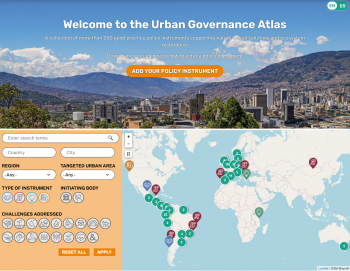
The Urban Governance Atlas is an interactive online database of over 250 policy and governance instruments for urban ecosystem restoration and green space planning, including dedicated strategies and plans, planning instruments (targets, standards, scoring, green space factors), financial
- Document
- Guidance
- Video
What is Ecosystem Restoration
Ecosystem restoration means assisting in the recovery of ecosystems that have been degraded or destroyed, as well as conserving the ecosystems that are still intact. Healthier ecosystems, with richer biodiversity, yield greater benefits such as more fertile soils, bigger yields of timber and fish,
- Consultancy
- Document
- Guidance
Sistema de monitoreo de la biodiversidad y los servicios de los ecosistemas en el cantón de Curridabat
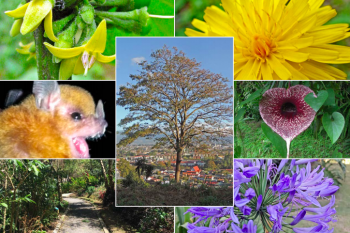
Acomienzos del 2015, el cantón de Curridabat desarrollo su visión o modelo de desarrollo denominado Ciudad Dulce, que a la vez se constituyo en la base del Plan de Gobierno Multidimensional. Impulsado por el municipio local busca beneficiar 75.000 habitantes residentes a través de la creación y
- Document
- Image
- Infographic
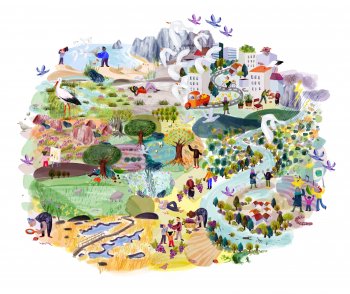
NetworkNature Visualisation: EU-Funded Nature-based solutions research projects addressing Societal Challenges across Ecosystems
In this document you can find a visual representation of the different types of ecosystems and most relevant societal challenges in the context of NbS, with the aim to simplify and communicate these concepts, while inspiring NbS good practices. || The European Commission defines Nature-
- Infographic
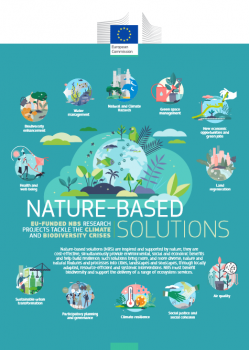
Nature-based solutions-EU-funded NbS research projects tackle the climate and biodiversity crisis
Nature-based solutions (NbS) are inspired and supported by nature, they are cost-effective, simultaneously provide environmental, social and economic benefits and help build resilience; such solutions bring more, and more diverse, nature and natural features and processes into cities, landscapes
- ‹ previous
- 27 of 45
- next ›